

The Renters' Rights Act 2025 comes into force on 1 May 2026. The law has been covered extensively. What most letting agencies still need is a clear answer to one practical question: what exactly should we be doing right now?
This checklist sets out ten operational actions for letting agents. It is designed to sit alongside our companion guide — Renters' Rights Act 2025: what changes on 1 May 2026 — which covers what the legislation actually does. This article focuses on what your agency must do before that date to operate compliantly from day one.
Ten actions before 1 May 2026
✓ Audit your managed portfolio
Before anything else, you need to know exactly what you are managing. Pull a full report from your CRM and categorise every tenancy by:
- Tenancy type: fixed-term AST, statutory periodic, or contractual periodic
- Agreement status: written agreement in place, or verbal only
- Upcoming events: rent reviews, lease end dates, outstanding notices
- Student HMOs: properties where landlords may intend to rely on Ground 4A
This is not an admin exercise. It is the foundation for every other step on this list. Without an accurate portfolio map, you will miss tenancies requiring the information sheet, mishandle the Section 13 notice timeline, and fail to identify landlords who need immediate advice on possession.
✓ Prepare your written statement template
From 1 May 2026, every new assured periodic tenancy must include a prescribed written statement of terms before the tenancy is entered into. Based on the January 2026 draft regulations published by the government, it must include at minimum:
| Required detail | What to include |
|---|---|
| Names of parties | Full legal names of landlord(s) and tenant(s) |
| Property address | Full address of the rental property |
| Tenancy start date | The date the tenancy legally begins |
| Rent amount and frequency | Amount, payment date, and method |
| Deposit details | Amount, scheme name, and protection reference |
| Repair obligations | Summary of landlord and tenant responsibilities |
| Notice procedures | How either party ends the tenancy |
| Pet and subletting clauses | Any restrictions or conditions agreed |
The government has said it will publish a final prescribed format in March 2026. Watch for that publication and update your template immediately on release. The written statement can be incorporated into your tenancy agreement or served as a separate document, but it must be provided before signing. Failure to serve it carries a starting penalty of £4,000.
✓ Identify existing tenants with no written agreement

If a landlord has an existing tenancy running on a verbal agreement, the standard information sheet alone is not sufficient. Under the Act, those tenants must receive both the information sheet and a full written statement of terms.
Search your CRM now for any managed tenancy without a signed written agreement on file. For each one, draft a written statement and plan service before 1 May.
This group is small in most managed portfolios but high-risk: it sits at the intersection of two separate compliance obligations, and missing either carries a financial penalty.
✓ Serve the government information sheet on all existing tenants by 31 May 2026
Every existing AST, fixed-term or already periodic, converts automatically to an assured periodic tenancy on 1 May 2026. Landlords do not need to re-issue new tenancy agreements. They do, however, need to provide every tenant with a government-published information sheet explaining how the changes affect their tenancy.
Deadline: 31 May 2026
Starting penalty for failure: £4,000 per tenancy.
The government has confirmed the final information sheet will be published in March 2026. The moment it is released:
- Download and store it centrally
- Set up a bulk-service process — whether via email, post, or your tenant app
- Log date of service for each tenancy with proof attached
- Include guarantors where the tenancy has one
Given volumes involved in a managed portfolio, manual service is not realistic. Set up a templated process now and be ready to deploy it on or shortly after the information sheet's publication date.
✓ Review all property listings and marketing materials
Two new obligations apply directly to how you advertise rental properties:
Asking rent must be stated clearly. Every listing, across every platform, must display a fixed asking rent. The stated figure is the ceiling for what can be accepted.
Rental bidding is banned. Agents must not ask for, encourage, or accept offers above the advertised rent. Starting penalty: £4,000.
Alongside this, discriminatory advertising becomes unlawful. "No DSS", "professionals only", "no children", and any equivalent language must be removed immediately from:
- Rightmove, Zoopla, and any other portal listings
- Social media adverts
- Internal call scripts and negotiator guidance
- Landlord instruction letters and templates
- CRM notes and auto-generated correspondence
✓ Restructure your payment process
The current practice of taking multiple months' rent in advance to manage affordability risk is prohibited from 1 May. Agents and landlords can only require one month's rent in advance, and only after all parties have signed the tenancy agreement.
The required three-step sequence is:
- Confirm cleared funds for the holding deposit: before referencing begins
- Confirm cleared funds for the security deposit: once the tenancy offer is accepted
- Offset the holding deposit and collect the balance of the first month's rent: only once the agreement is fully executed by all parties
Retrain your lettings and client accounts teams on this sequence before May. Build it into your onboarding process as a hard workflow gate. Any rent collected before the agreement is signed must be returned — accepting it is a breach. Ensure landlord compliance documents (gas safety certificate, EICR) are also confirmed before execution, since that moment creates a binding contract.
✓ Review outstanding possession cases and Section 8 readiness
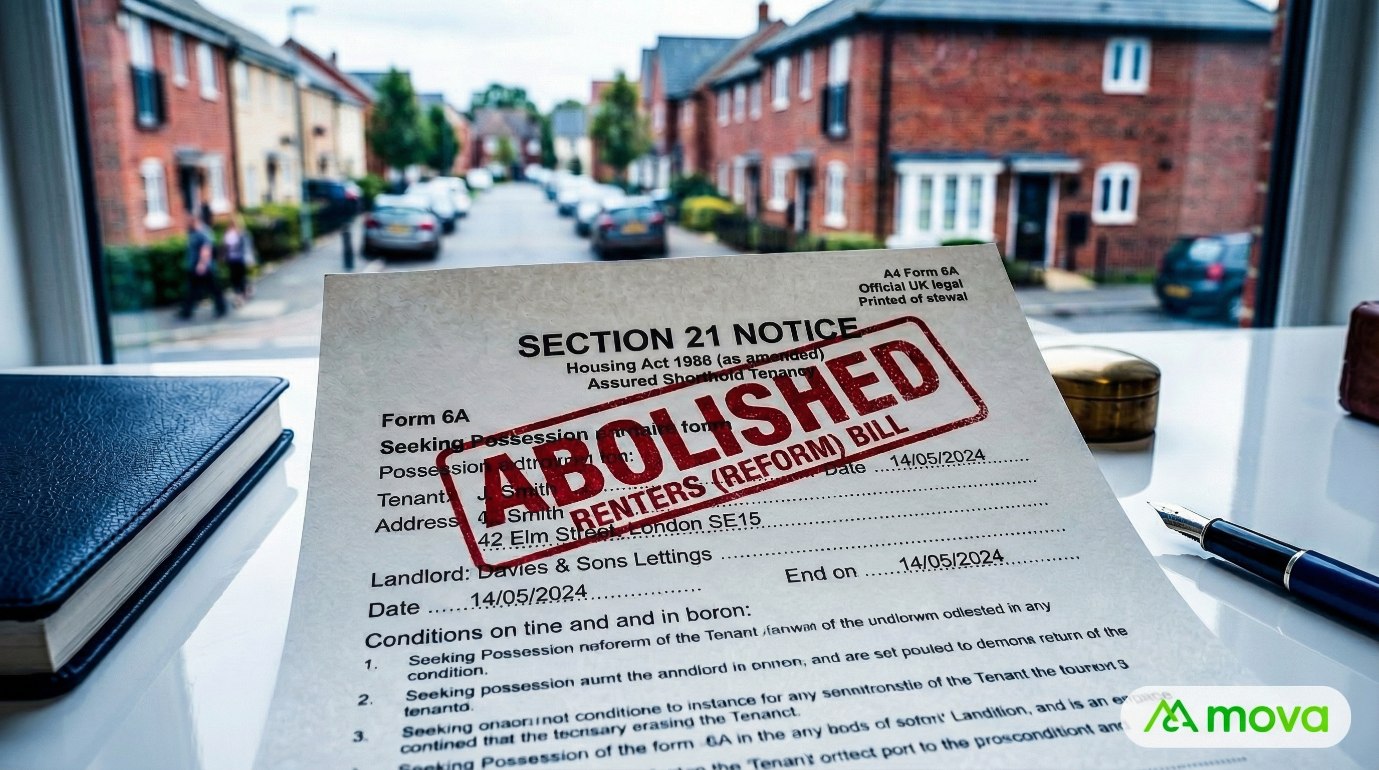
Section 21 cannot be used after 30 April 2026. If you have landlords who are seriously considering recovering possession in the near term — for sale, occupation, or persistent rent arrears — assess those cases now.
Where a Section 21 notice is legally appropriate to serve before 1 May, this may provide greater certainty than waiting for the Section 8 process, given current court timelines. Take legal advice case by case.
For all managed landlords, ensure your team understands:
- Which Section 8 grounds apply to their situation (arrears, antisocial behaviour, landlord occupation, sale)
- What notice periods each ground requires (two months for most, four months for Ground 1 and 1A)
- The 12-month protected period: landlords cannot rely on Ground 1 (occupation) or Ground 1A (sale) until the tenancy has been running for 12 months — in practice, notice can be served from month eight given the four-month notice period
- What evidence landlords must retain and how your agency will hold it
✓ Update your rent review workflow
All rent increases must now follow the Section 13 statutory process. Notice periods extend from one month to two months. Increases are capped at once every 12 months. Tenants can challenge proposed increases at the First-tier Tribunal.
For converting tenancies, the 12-month clock does not reset on 1 May — it continues from the date of the last increase or tenancy start date. This means some landlords will find themselves unable to increase rent until late 2026 or beyond.
✓ Update your CRM for a periodic tenancy world
Many CRM workflows are built around fixed-term tenancies: lease expiry alerts, renewal prompts, and end-of-tenancy processes. These will break in a periodic tenancy world if not reviewed.
Audit your CRM configuration and identify every automated workflow that references a fixed end date. Replace fixed-term logic with:
- Rent review reminders triggered from the last increase date
- Section 13 notice preparation prompts at ten months
- Section 8 ground eligibility flags for possession-related cases
- Information sheet service tracking for all existing tenancies
✓ Retrain your team by role before April
The Renters' Rights Act changes something in almost every role in a letting agency. A single all-hands briefing is not sufficient. Training needs to be role-specific:
| Role | Key training areas |
|---|---|
| Negotiators | No bidding, stated asking rent, non-discrimination in qualifying conversations, payment sequencing |
| Property managers | Section 8 grounds, Section 13 rent reviews, pet request handling, written statement service |
| Administrators | CRM updates, information sheet distribution, proof of service logging |
| Client accounts | Three-step payment workflow, rent-in-advance rules, voluntary overpayment handling |
| Branch managers | Penalty exposure by breach type, landlord communication templates, possession case triage |
Training delivered in April is better than none, but it leaves no margin for error. Start now.
The commercial case for doing this properly
The agencies that will strengthen their position over the next twelve months are the ones that use this transition to demonstrate operational competence to landlords. The paperwork burden is real, but it is also a differentiator. Landlords under pressure need agents who can give them clear, confident advice on notices, rent reviews, and tenant relations under the new framework.
Every item on this checklist is also a landlord retention conversation. Work through it early, and you have a reason to contact every client with something useful to say.
For a full explanation of what the Renters' Rights Act changes on 1 May 2026, see our companion guide: Renters' Rights Act 2025: what changes on 1 May 2026.